
Onshore UK · East Midlands & Cleveland Basin
The UK remains an important part of the portfolio, with producing and appraisal-stage assets that contribute to near-term cash flow and domestic energy supply. Projects such as Wressle and Cloughton are well positioned within the context of the UK’s ongoing energy transition.
| Licence | Field / Prospect | Operator | Working interest | Status |
|---|---|---|---|---|
| DL003 | West Firsby | Europa | 100% | Production |
| PEDL180 | Wressle | Egdon Resources | 30% | Production |
| PEDL182 | Broughton North | Egdon Resources | 30% | Exploration |
| DL001 | Crosby Warren | Europa | 100% | Production |
| PEDL343 | Cloughton | Europa | 40% | Appraisal |
West Firsby
The field was discovered in Dec’87 by Enterprise Oil & Gas with their WF-1Z (L46/18-7Z) side-track of the WF-1 well after 42 days of drilling. Enterprise drilled a further two wells to appraise the field, WF-2 in Aug’88 and WF-3 in Oct’88.
Tullow and Edinburgh Oil & Gas plc took over the field and drilled WF-4 in Nov’92, WF-5 in Sep’95 and WF-6 in Oct’96.
Europa Oil & Gas acquired the field from Tullow in ’03 and drilled side-track WF-7 in Jan’04 using WF-5 as a donor well and side-track WF-8 in Mar’05 using WF-1Z as donor. The latest well WF-9 was drilled from surface in Feb’11. Nine wells in all have been drilled on the site but there are only seven well heads.
The West Firsby field exemplifies the classic east Midlands oil play, sourced by early Namurian pro-deltaic shales. Stacked fluvio-deltaic sandstone reservoirs of late Namurian to early Westphalian A age are structured into a Variscan inversion anticline in the hanging wall of the NE boundary fault (Morely-Campsall fault) of the Gainsborough Trough (Dinantian-Namurian).
| Full Field Volume Classification | Symbol | Unit | 1P/P90 | 2P/P50 | 3P/P10 |
|---|---|---|---|---|---|
| Stock Tank Oil Initially In Place | STOIIP | MMstb | 10.458 | 14.204 | 18.64 |
| Cumulative Production | NP Jul’25 | MMstb | 1.753 | 1.753 | 1.753 |
| Recovery Factor | RF Jul’25 | xP/xP | 16.76% | 12.34% | 9.40% |
| Economic Ultimate Recovery | EUR | MMstb | 1.765 | 1.767 | 1.768 |
| Recovery Factor for EUR | RF EUR | xP/xP | 16.88% | 12.44% | 9.49% |
| Remaining Reserves | RR Jul’25 | MMstb | 0.013 | 0.014 | 0.016 |
| Contingent Resources STOIIP | CR STOIIP | MMstb | 4.922 | 7.076 | 9.690 |
| Contingent Resources UR | CR UR | MMstb | 0.500 | 0.750 | 1.000 |
| Licence | DL003 |
| Working interest | 100% |
| Operator | Europa |
| Status | Production |
| Expiry | 2030 |
| Wells | 2 |
| Basin | East Midlands |
| Play | Carboniferous |
Wressle
History
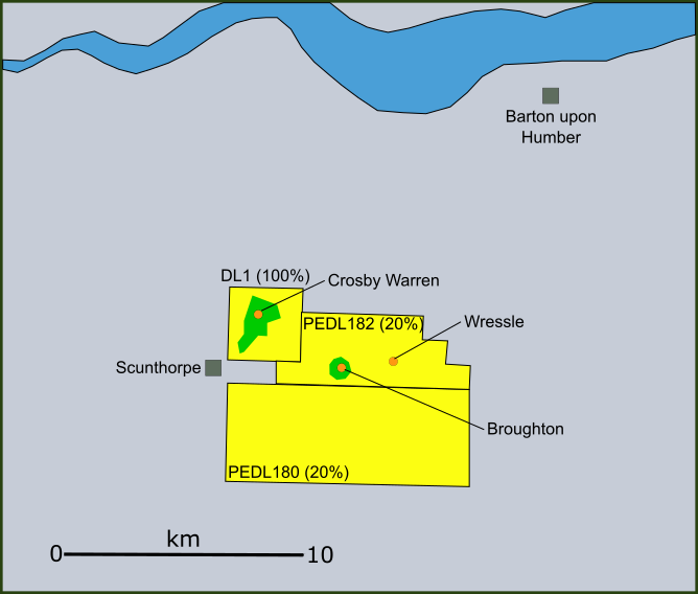
The Wressle oil discovery straddles PEDL180 and PEDL182. It lies 5km southeast of, and along the same structural trend as, the Europa-operated Crosby Warren field which has been producing oil for almost 30 years. The field was discovered by the Wressle-1 conventional exploration well which was drilled to a total depth of 2,240m (1,814m TVDSS) on 23 August 2014. Petrophysical evaluation of measurement whilst drilling (MWD) log data indicated over 30m measured thickness of potential hydrocarbon pay in three main intervals:
- Ashover Grit – up to 6.1m measured thickness of potential hydrocarbon pay
- Wingfield Flags – up to 5.6m
- Penistone Flags – up to 19.8m
Four intervals were tested between February and March 2015:
- Ashover Grit – 80bopd and 47 thousand cubic feet of gas per day (mcfd), free flow;
- Wingfield Flags – up to 182bopd and 0.456 million cubic feet of gas per day (mmcfd), free flow;
- Penistone Flags zone 3 – up to 1.7 mmcfd and up to 12bopd, free flow; and
- Penistone Flags zone 3a – 77bopd, swabbed
The results facilitated the design of an Extended Well Test (EWT) programme to quantify the production levels that could be attained from pumped production. Reservoir engineering analyses indicates that an initial production flow rate of 500bopd gross from the Ashover Grit interval. A CPR was issued on 26 September 2016 which identified gross 2P reserves on the Wressle structure of 0.65mmboe in the Ashover and Wingfield Flags and gross 2C contingent resources of 1.86mmboe in the Penistone Flags. The EWT provided the basis for the Field Development Plan (FDP) which was submitted on 8 September 2016.
Works to reconfigure the site for production commenced at the end of July 2020, however production started at the end of January 2021. Modest production continued, off and on until the middle of August in 2021 and following the proppant squeeze. The successful operation bypassed the near hole skin damage caused by the drilling and the field was able to achieve flow rates just under 1000BOPD.
Wressle remains one of the most productive onshore UK oilfields currently in operation, with gross production from the Wressle-1 currently averaging 281 barrels of oil per day, with Europa’s net share equating to 84 bopd. Operations at Wressle are cash generative.
The Wressle partners are progressing a development plan to deliver the next phase of production growth. This includes a new development well targeting the Penistone Flags reservoir where gross Mid-case Contingent Resources of 1.53 million barrels of oil and 2 billion cubic feet of gas have been independently reported, as well as a solution to monetise associated gas being produced from the field, which sits just 600 metres from the local gas distribution network. A seismic interpretation and mapping exercise has highlighted a potentially significant uplift in resources from the Ashover Grit, and the results have been incorporated into the updated field development plan.
A planning application for the Penistone Flags reservoir development is set to be determined by North Lincolnshire Council. The works will include extending the existing Wressle site to accommodate the drilling of new development wells and the construction of gas processing facilities, together with an underground gas pipeline to connect the field to the local distribution network.
| Licence | PEDL180 |
| Working interest | 30% |
| Partners | Egdon Resources (30%); Union Jack Oil (40%) |
| Operator | Egdon Resources |
| Status | Production |
| Expiry | 2039 |
| Wells | 1 |
| Basin | East Midlands |
| Play | Carboniferous (conventional) |
Broughton North
PEDL182 holds the Broughton North prospect, in a fault block immediately to the northwest of Wressle. ERCE Equipoise in its capacity as a Competent Person has assigned a high geological chance of success, between 40% to 49%, to the prospect as well as gross mean unrisked prospective resources of 0.6 million boe.
| Licence | PEDL182 |
| Working interest | 30% |
| Partners | Egdon Resources (30%); Union Jack Oil (40%) |
| Operator | Egdon Resources |
| Status | Exploration |
| Expiry | 2039 |
| Wells | N/A |
| Basin | East Midlands |
| Play | Carboniferous (conventional) |
Crosby Warren
Crosby Warren is a small mature oil field located NE of Scunthorpe in Licence DL001. Europa Oil & Gas is operator with a 100% interest in the field.
The CW-1 discovery well was drilled by RTZ Oil & Gas in Mar’86 to test an up-dip fault folded closure at the northern end of the Brigg-Broughton trend.
After drill stem testing the top four Namurian sands, two sands (the Rough Rock & the Beacon Hill Flags ~100m below) were recognised as potential reservoirs, and the well completed to allow testing in cased-hole. Three zones were perforated and tested:- the highest (the Rough Rock) produced gas/water and the lowest (the Upper Kinderscout Grits) produced only water, so both were dismissed as unprospective. However the Beacon Hill Flags tested at a rate of 144 bopd for 8 hrs, and sustained an oil-rate of about 50 bopd dry oil for 3 days during appraisal testing. During further appraisal testing, the Beacon Hill Flags produced at around 500 bopd of dry oil for 24 days, after a sand propped proppant squeeze job. From pressure build-up tests performed during the appraisal testing, Beacon Hill Flags permeability is estimated at 5-10md.
Sidetrack well CW-2y was drilled by Europa Oil & Gas in Jul’07 and found an OWC between 1561.3-1564.3m TVD-MSL, though it’s likely this was a “current” rather than an original OWC, due to aquifer influx. Since CW-1 started to cut water in ’01, all produced water has been re-injected down initial producer CW-3z into the Beacon Hill Flags. Consequently, the reservoir recovery mechanism is a combination of solution gas drive, natural aquifer influx enhanced by water injection.
| Full Field Volume Classification | Symbol | Unit | 1P/P90 | 2P/P50 | 3P/P10 |
|---|---|---|---|---|---|
| Stock Tank Oil Initially In Place | STOIIP | MMstb | 2.9 | 3.6 | 4.7 |
| Cumulative Production | NP Jul’26 | MMstb | 0.918 | 0.918 | 0.918 |
| Recovery Factor | RF Jul’26 | xP/xP | 31.66% | 25.50% | 19.53% |
| Economic Ultimate Recovery | EUR | MMstb | 0.958 | 0.990 | 1.027 |
| Recovery Factor for EUR | RF EUR | xP/xP | 33.03% | 27.50% | 21.84% |
| Remaining Reserves | RR Jul’26 | MMstb | 0.040 | 0.072 | 0.109 |
| Licence | DL001 |
| Working interest | 100% |
| Operator | Europa |
| Status | Production |
| Expiry | 2027 |
| Wells | 2 |
| Basin | East Midlands |
| Play | Carboniferous (conventional) |
Cloughton
PEDL 343 contains two adjacent blocks, TA09 and SE99a and covers 110 square kilometres. Block TA09 is located north of Scarborough running up the east coast and Block SE99a is located to its west.
The Cloughton-1 discovery well was drilled by Bow Valley in 1986 and encountered gas throughout the Carboniferous section. Four zones were tested, three of which were in the Carboniferous, the other within the Permian dolomitic limestone. The Cloughton-1 well test achieved rates of up to 28,000 scf/day on natural flow, however with the right completion and production optimisation techniques it is believed a well could flow at 6 mmscft/day. The gas is sweet good quality gas with >98% methane and ethane.
Log and core data indicates that porosities within the Carboniferous section are 2-9% with permeabilities of between 0.1 and 1mD.
The well was drilled crestally on the Cloughton anticline which is a NNW/SSE trending anticline with significant dip closure in all directions. Around 60m of Carboniferous net sandstone was realised with high gas saturations.
Europa has completed a preliminary audit of the gross Cloughton gas in place volumes which has resulted in a Pmean GIIP of 192 BCF and a range as detailed in the following table:
| Cloughton | P90 | P50 | Pmean | P10 |
|---|---|---|---|---|
| GIIP – BCF | 118 | 184 | 192 | 274 |
Europa regards Cloughton as a gas appraisal opportunity with the critical challenge being to obtain commercial flowrates from future production testing operations. A location for an appraisal well pad has been identified and following successful testing operations the field would be monetised by connecting to the nearby gas grid.
Planning approval for a test well was denied by North Yorkshire Council in May 2026, despite the council’s own planning officers’ recommending approval. Our application was supported by 13 independent technical reports confirming that the selected pad location at Burniston Mill is well-suited for the temporary appraisal well.
The Company is currently assessing its options with a view to appealing the decision.
Europa has opened a data room for Cloughton and is actively seeking a farm-in partner to fund the next stages of appraisal. Domestically produced gas generates employment, contributes local and national tax revenues, and carries a materially lower carbon footprint than the imported gas on which the UK is increasingly dependent, making Cloughton’s development consistent with both the UK Government’s British Energy Security Strategy and its Net Zero 2050 objectives.
| Licence | PEDL343 |
| Working interest | 40% |
| Partners | Egdon Resources (40%); Petrichor (20%) |
| Operator | Europa |
| Status | Appraisal |
| Expiry | 2046 |
| Wells | N/A |
| Basin | Cleveland |
| Play | Carboniferous sandstone |